
Tap the map to dispatch the nearest band
Travelling Bands
A band rides a motorcycle to your school hall — and forty children sing their own lullabies back in English.
A child can sit through six years of English lessons and still not be able to say anything.
English arrives in most classrooms as a subject on a timetable: a book, a blackboard, a column of words to copy, a test on Friday. The children who come out of it actually speaking overwhelmingly heard it somewhere else — at home, on a screen, from a relative abroad. The standard fix is more English, earlier and faster. It asks a seven-year-old to hold a foreign set of words and a foreign music of stress, rhythm and breath at the same time — two unknowns at once — and then reads the result as a lack of aptitude. Meanwhile every child in that room walked in already knowing thirty songs by heart: the rhymes a grandmother sang, the lullaby that puts a younger sibling down, the counting song from the yard. Nobody has thought to use them.
The turn
Don't teach a child an English song. Give them their own song, in English.
Travelling Bands is a network of travelling music teachers who teach English as a second language by singing it. The songs are not ours and they are not imported: the band learns the nursery rhymes and lullabies of the region it rides, and hands them back translated, line by line, as singable English. The melody is the half the child already owns. Pitch, pulse, where the breath goes, which syllable lands hard, how the last line resolves — all of it memorised, usually before they could speak in sentences. Swap the words in and the lesson carries one unknown instead of two. It also smuggles in what a vocabulary list never can: a whole sentence, at speed, with its own cadence, sung forty times by a child who believes they are only singing. Pronunciation and phrasing ride in on the tune instead of being corrected into place. And it runs both directions. A rhyme a class has sung since infancy, sung back in English, is the same rhyme — so the English is not a replacement for the mother tongue, it is a second coat of paint on something the family already keeps. Parents hear the tune from the next room and recognise it. The obvious version of this company is a booking marketplace for session musicians — weddings, parties, corporate events. The booking half would work; the retention half would not, because a wedding band is hired once. A school with a gap in its English teaching rebooks every week without being chased. So the whole company is pointed at that one customer: stage gear traded for kits sized to a classroom, and a set list traded for the songs the children already know.
How it works
- 01
A school books a slot
A school requests a session through the dispatch platform — a date, a rough grade band, how many classes will be in the hall, and the languages actually spoken in them. No call, no quote to negotiate. Confirmation comes back with a pre-visit checklist generated automatically: floor space, whether there is power for a small battery PA, and one question for the teacher worth more than the rest — which four songs does this class already know by heart?
- 02
The band learns the school's own songs
This is the step the business actually turns on. Before the ride, the band works up the four songs the class named: the melody as the children sing it locally, not as a songbook prints it, and an English lyric fitted to that melody syllable for syllable so it can be sung at tempo rather than read. Fitting the English to an existing tune is a craft job, not a translation job. A line has to land the stress where the melody lands it, resolve where the phrase resolves, and still mean roughly what the original meant — which is why the repertoire is built once, carefully, and then rides to every school in the region that shares the song. The repertoire compounds. Every region's rhymes get worked up once and then belong to the network, so the hundredth school in a district is cheaper and better served than the first.
- 03
The band rides in
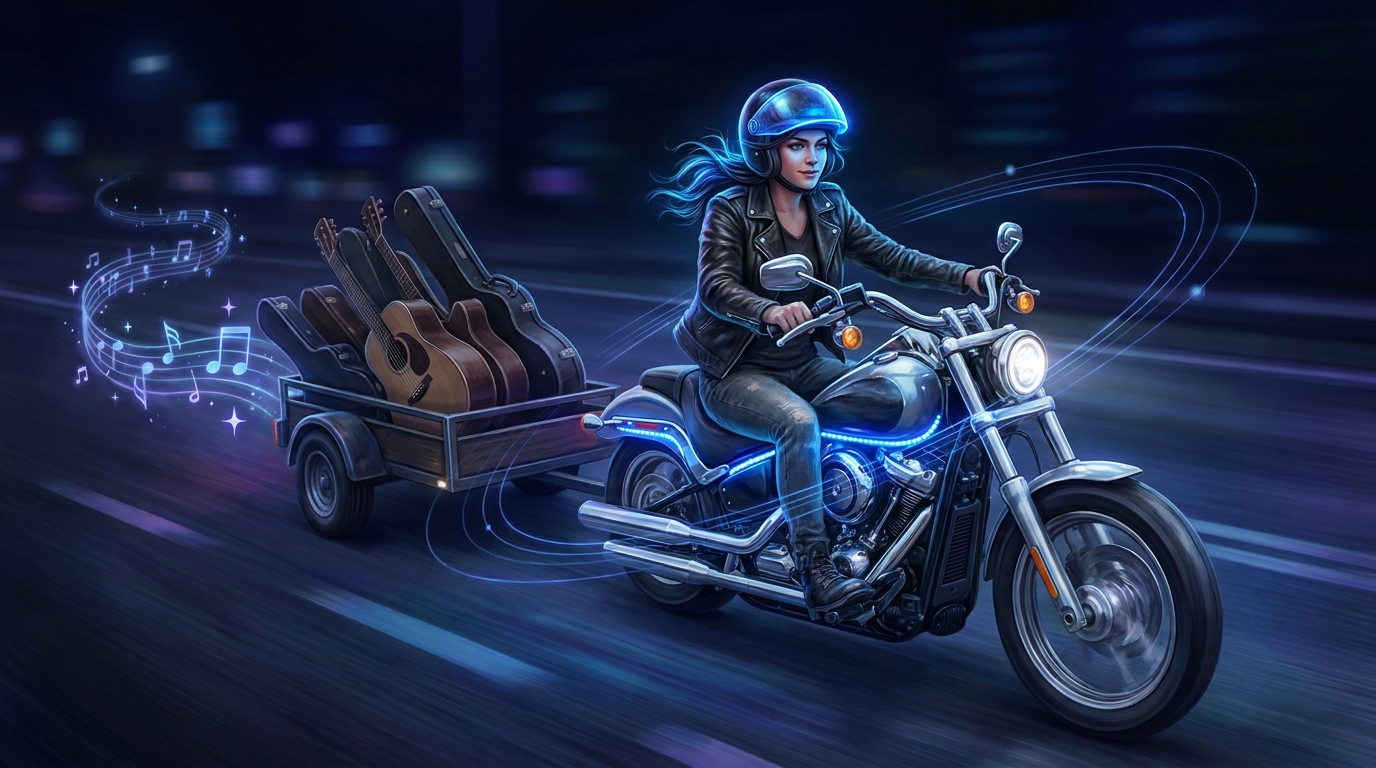
A motorcycle pulling a small enclosed trailer of instruments arrives at the gate, and the kit is unloaded and set up in the hall in under ten minutes. No performer will reach this gate without having cleared a background check and safeguarding training first, as a condition of being on the platform at all rather than a policy added after something goes wrong. No band has ridden out yet, and the platform that would hold that condition does not exist.
- 04
The 45 minutes that follow
The first five minutes are the entrance itself — instruments coming off the trailer in front of the room, and a song the children recognise already starting before everyone has found a seat. In their own language, first, on purpose. By minute ten the band has sorted the room into two or three groups by ear, through call-and-response on that same song — which means the sort measures English, not musicianship, and takes no test and no clipboard to do it. Minutes ten to twenty-five are the swap. One line of the rhyme at a time, in English, on the tune the room already knows: band sings it, room sings it back, nobody is asked to read anything. One band member works the group that is further along on a full verse while another keeps the newer group on a single repeated line. Minutes twenty-five to thirty-five bring the room back together for the whole song in English, start to finish, at speed — the moment that gets filmed on someone's phone and sung to a parent that evening, which is also the moment the parent discovers the child can say forty words of English. The last ten minutes are cool-down, a practice assignment posted straight to the app, and the case going back on the trailer.
- 05
Kids keep going after the band leaves
The session is logged against the same level ladder Sing to Learn uses, and the song the band taught is waiting in the app that night — same melody, same English lyric — so a child practising at home starts exactly where the visit left off, not from the beginning.
The kit, unpacked
- 1Two guitars — sized for smaller hands, not stage-scale
- 2Hand drum — carries rhythm without needing power
- 3Battery PA — lunchbox-sized, fills a hall, no mains needed
- 4Portable keyboard — folds flat for the ride
- 5Level cards, tuner, spare strings — the on-the-spot grouping game, plus repairs
- 6First-aid kit — same standard any vehicle on the network carries
The kit stays deliberately small: everything has to come off one trailer, into one hall, in minutes, and go back on the same way. Two guitars sized for smaller hands, a hand drum, a battery-powered PA the size of a lunchbox, a portable keyboard, a set of laminated song cards carrying each rhyme in both languages, a spares pouch of strings and a tuner, and a first-aid kit travel in every trailer — nothing that needs mains power, nothing that can't survive a rough road. The real asset on the trailer is not the gear. It is the songbook: each local rhyme with its own melody as the region sings it, a singable English lyric fitted to that melody, and the two or three lines a band leads with for a class that has never sung in English before. The trailer itself is sized so that the same motorcycle licence that gets a rider to work already covers towing it, by design — the fleet is designed around the vehicle a rider can already operate, not the other way around.
Teaching at the right level
Grouping children by their actual current ability, rather than age or grade, and teaching foundational skills at that level, is the core insight behind Teaching at the Right Level (TaRL) — developed by Pratham and evaluated in randomized trials across more than eighty million children. source A travelling band applies that insight live, and applies it to language: the call-and-response in the first ten minutes sorts a hall by how much English a child can already hold, using a song every one of them knows, so the measurement costs nothing and embarrasses nobody. It is also the one thing an app alone can't do as well — a room of forty children at three different starting points is exactly the situation a live teacher can read and regroup in real time, session to session, in a way one screen serving one child was never built for. That call-and-response sorting is a live, no-paperwork version of the same right-level principle running under every venture in this portfolio. See the methodology
Where it lives
The plan is for Travelling Bands to run background-checked bands across a handful of regions, dispatched on a booked rather than fully on-demand basis, with the marketplace-liquidity question tested region by region in practice. Session volume is expected to start modest and grow steadily rather than explosively. The aim is for each session to pay for itself, and for expansion to be funded out of session income, region by region. A typical day will start before the sun's properly up: a kit check at the depot, the trailer loaded in a fixed order so nothing shifts on the ride, then the first school by half past eight. Between visits the roads will be whatever they are — paved for a while, then not — and a broken string will get swapped in the two minutes before the next class walks in, not treated as an event. The last stop of the day will end with the case back on the trailer, the next two weeks' bookings already sitting in the app, and the ride home. Same songs, same levels, same idea from two directions: Sing to Learn teaches a second language through the lullaby a parent already sings at bedtime, and the band teaches it through the rhyme a class already sings in the yard. One goes home in a parent's pocket; the other arrives on a motorcycle and makes the whole hall do it out loud. See Sing to Learn
What we don’t know yet
That singing a known melody with new words beats ordinary song-based language teaching is the bet, and it is not yet measured. The mechanism is plausible and the classroom reaction is easy to predict; a controlled comparison against a class taught the same vocabulary through imported English songs is the test that would settle it, and it has not been run. The business model is still an open question the company is actively working out, not one it has settled and is choosing not to say: a marketplace take rate, school-purchased term contracts, and sponsorship from an instrument brand or foundation are all live candidates. The honest read is that a fully on-demand marketplace — the model a company like this would reach for first — may not fit something as non-fungible as a touring band. Whether band members are employees or contractors, and whether the fleet is owned by the company or brought by each band, are both still open — the choice changes the balance sheet and the legal picture far more than it changes what a school actually experiences. Which single geography to concentrate the network in first is also unresolved: the regulatory and safety answers for the same idea look very different depending on where the motorcycle is actually riding — and so does the songbook, which has to be built again from scratch for every language the network enters.