
100 Guitars
A hundred children in Budhabare, Jhapa picked up a guitar for the first time, grouped by ability from day one, and played together by the end of term.
Teach a hundred children guitar at once, and the room moves at the pace of whoever already knows how.
Group music lessons default to whoever is already ahead — the fast student stays engaged, the slow one falls further behind, and the gap only widens the longer the room stays fixed at one page. A hundred first-time guitarists make that gap wider before lunch: some arrive already able to hold a chord, most have never touched a string, and a single one-size lesson plan serves almost none of them well.
The turn
So the hundred are never taught as one class — they're grouped, and re-grouped, by what they can already do.
Every child is placed by demonstrated ability, not age or grade, starting in the very first session — and moved again as they improve, so a fast starter is never bored and a first-timer is never lost. That one decision is what turns a room of a hundred guitars into a hundred students, each being taught at the level that's actually theirs.
How it works
- 01
A placement, not a lesson
Before any group forms, every child plays whatever they already know — nothing, a little, or a fair amount — so cohorts are built on demonstrated ability from the very first session, not on age or grade.
- 02
Small cohorts, re-grouped as they grow
The hundred split into small groups matched by genuine starting level. As a child's playing moves, so does their group — nobody stays bored at the back or lost at the front for a whole term.
- 03
One guitar, kept, not shared
Each child keeps a single guitar for the length of the programme instead of passing round a shared classroom set — the same instrument, the same calluses, session after session.
- 04
Two teachers who stay after the crew leaves
Two local teachers are retained past the initial visit specifically to keep the instruments strung, tuned, and taught between sessions — the programme's answer to what happens once the visiting crew is gone.
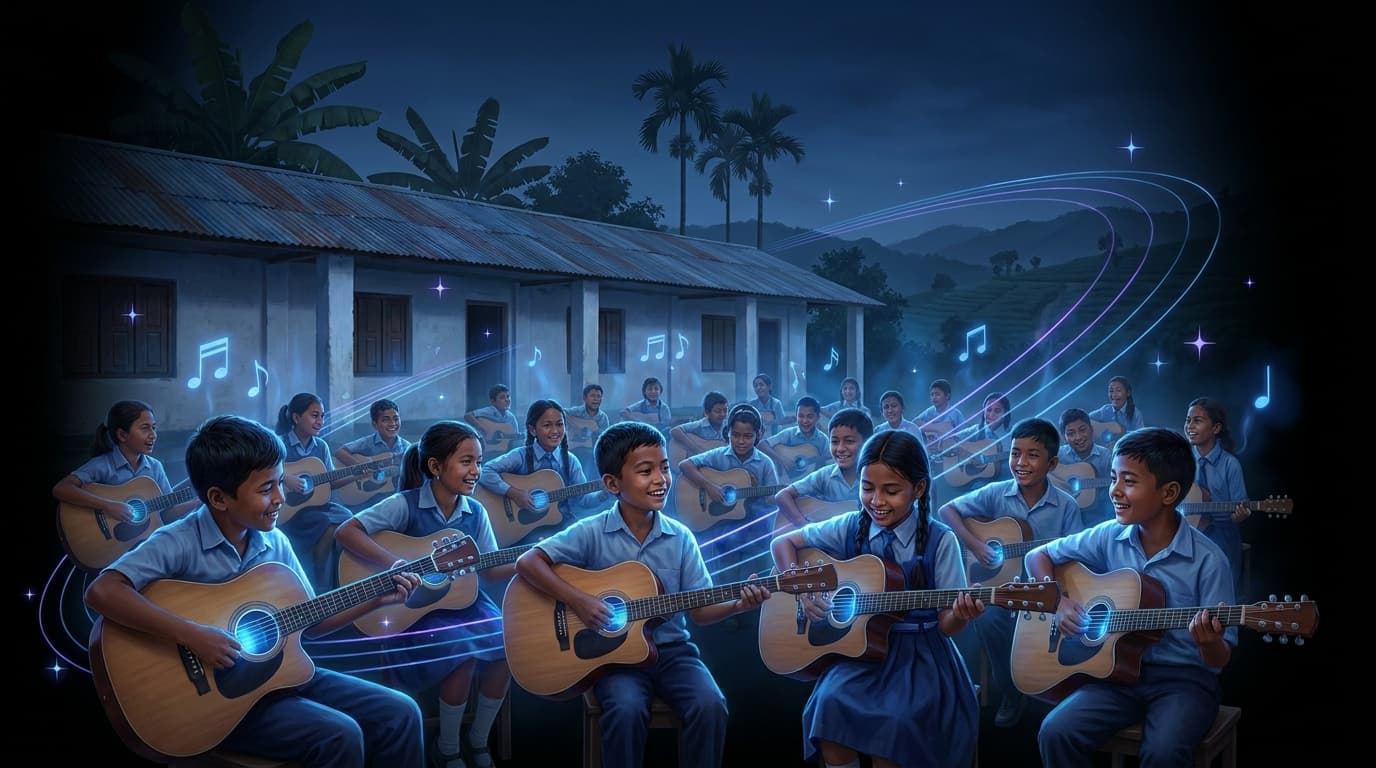
A hundred steel-string acoustics, chosen for being cheap to keep in tune and durable enough to survive a first term of use by children who have never held one before. Keeping one playable — a fresh set of strings, the odd repair — costs a small fraction of what the instrument itself did, which is why the two retained teachers matter as much as the guitar count. The count is also the point: a hundred is a number that photographs on its own, and by the end of the first term the cohort could be counted the same way it started — a hundred children, a hundred guitars, now a hundred players.
Teaching at the right level
Teaching at the Right Level — developed by the Indian NGO Pratham and evaluated over fifteen years in randomized trials by J-PAL researchers — groups learners by actual ability rather than age or grade, and has produced some of the largest measured learning gains of any rigorously evaluated education programme. source 100 Guitars applies the same principle to an instrument instead of a textbook: ability-based grouping from the first session, and cohorts that move as a child's playing does, not on a fixed term-long timetable. See the full methodology
Where it lives
Budhabare, Jhapa sits in Nepal's eastern terai — flat, subtropical, and a full day's travel from Kathmandu, which is exactly why a programme here needs local teachers who stay, not a crew that visits once. The two retained teachers are the actual craft on display: keeping a hundred guitars strung and in tune between sessions is unglamorous, constant work, and it's the work that decides whether a hundred instruments are still being played in a year. It's the same district and the same community BeethovenJr's Jhapa Elephant Tracker project works in — one relationship, two different reasons to keep showing up. See Jhapa Elephant Tracker
What we don’t know yet
The entity that would eventually hold this project — company, fund, or foundation — hasn't been decided, and until it is, 100 Guitars is deliberately not run as a fundraising or donation operation. What happens with the footage beyond the people already following the project — a wider release, a festival, anything with a plan behind it — hasn't been decided either. Where the second cohort runs, and exactly when it starts, is still being worked out. Only the first has actually happened so far.